Posts

Showing posts with the label Investment Tips

Why PPF always better than Stock Market investments?

Image
If you look at the Indian Stock Market Sensex reached life time high 26420 and the annualized returns is just 9.15% during this 20 year holding period says the reports. After seeing this result, investors might look for an alternative options for their investments says the experts. In the investment market, there are several debt products, like the Public Provident Fund (PPF) , have generated better annualized returns of 10.46% in this period. Hence investment experts always suggests do invest some amount in the PPF as well. Though the difference looks small in percentage terms, it is actually big in final value. While the Rs 10,000 investment in SENSEX at the end of August 1994 grew to Rs 57,520, the same amount invested in PPF at that time has grown to Rs 73,124. However, some of experts says, this study is no suggestion that a PPF is a far better option than equities at all times, it just reinforces the fact that timing is critical in the capital market. Despite the rece...

EPFO (Employee Provident Fund) would increase Interest Rate from 8.75% to 9.00% for 2014-15 FY on EPF

Image
The Employee Provident Fund Organization plans to increase the interest rate from 8.75% to 9% for the finacial year 2014-15. The sources says this is because of the India Markets situation is good now after new government formed. They see that good incresae in the investments which they have invested more then expected. This is a good news for the employees in India both Private and Government employees.

Under Section 80C, Tax Planning & Investments - Which is the Best Investment Option?

I googled for this information today, every where every one suggests to go with PPF (15 Yrs Term), NSC Bonds (6 Yrs Term), Tax Saving FDs (5 Yrs Term), Investment in Equity linked Saving Scheme (ELSS) (3 Yrs Term), LIC Policies Apart from 1 Lakh Savings (Under 80C), Rs.20,000 can be saved in to Infrastructure Bonds (Section 80CCF) PPF vs NSC: While PPF offers 8% per annum (p.a.), NSC offers 8% per annum compounded half yearly i.e., the effective yield is 8.16% per annum. Not a big difference. Here goes more information about PPF & NSC (PPF vs NSC - How to Decide?) Among all the tax-saving instruments under section (u/s) 80C, ELSS occupies the numero uno position (for details, please read “ELSS: The Best Section 80C Option”) but the ELSS schemes are inherently risky. So, if you’re not comfortable investing in ELSS, you can consider PPF (Public Provident Fund) or NSC (National Saving Certificate). Among the assured return schemes, both PPF and NSC occupy the top slot. B...

'LIC Jeevan Saral' Policy Review

Image
LIC’s Jeevan Saral is a participating endowment assurance plan that provides you death benefit like a term plan and a maturity benefit at the end of the policy term. Also since it is a participating plan, it would participate in the profits of the company and get its share of the profits in the form of loyalty additions which are terminal bonuses payable along with death benefit or maturity benefit. FEATURES: · Maturity value depends on the age at entry of the life assured. INVESTMENT MODES: You have the option of yearly, half-yearly, quarterly and monthly. In monthly mode, you have to pay through ECS. RETURNS · Maturity benefit: · Maturity sum assured + loyalty additions payable as lump sum. · Death benefit: · 250 times the monthly premium · Loyalty additions · Return of premiums excluding the first year premiums and extra/rider premium WITHDRAWAL: No partial withdrawal has been mentioned under this policy. However a partial surrender has been mentione...

Bank schemes better than PPF, NSC - 5 Yrs Fixed Deposit Rates Increased for Tax Planning Section 80C

Tax savings deposit schemes offered by most commercial banks still have a tiny edge over instruments like National Savings Certificate (NSC) or Public Provident Fund (PPF), in terms of interest rates. These banks are likely to keep their interest rates unchanged at least for the next 15 days, the period when income tax payers typically rush to invest in tax benefit schemes under Section 80C of Income-Tax Act, 1961. A majority of banks are offering a slightly higher interest rate on five-year tax savings deposits compared with the 8% rate on NSC or PPF, despite the across-the-board cut in bank interest rates over the last few months. In fact, top bankers often say that the 8% rate acts as a benchmark and banks don't want to breach it in order to hold on to the edge they have been enjoying over postal deposits. At present, State Bank of India, Allahabad Bank, Bank of Baroda and Central Bank of India are offering an 8.5% rate per annum on their five year tax benefit scheme. Ba...

Investment Tips: Nine stocks you could still bet on in economic uncertainties

Image
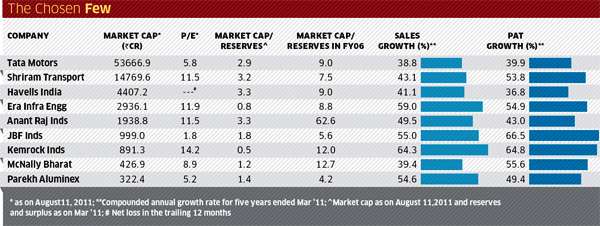
Equity markets across the globe are once again in a bear grip as uncertainties over global economic growth mount. In India, the benchmark indices have fallen by over 18% since January 2011. While it is still not clear whether the world will see another recession in a short span of two years, economists hint at a period of at least two-three quarters of stagnant economic activity. Doubts over future growth are likely to impact the stock market performance of companies in the near term making it all the more difficult for investors to pick the right investment avenues. In addition, when companies face periods of slower demand their bottom lines suffer. This makes earnings-based valuation techniques such as price-earnings ratios less relevant, at least in the near term. One needs to use other methods of evaluating the worth of a stock during times when sustained profit growth is unlikely. One technique is to find out companies, which have grown their reserves and surplus account signi...

Is Gold still a good Investment Option?

Image
Fears of new recession push investors to safe havens like Gold, Panic selling leading to market volatility, Gold a 'bubble that could deflate,' says analyst, Hidden dangers of investments in gold For Gopal, it was the yellow metal that added glitter to the portfolio. At a time when the markets were choppy and debt instruments not so lucrative, Gopal made a neat 18 percent profits on gold. That was within a short span of a year. Gold and silver were a significant part of his portfolio. He used them as an efficient hedge against looming uncertainties. Will this strategy work again for Gopal? The often-heard term 'inflation' is the rate at which prices of goods and services rise. It eats away the future purchasing power of the wealth you create painstakingly through meticulous investments. If you find it difficult to meet your monthly expenditure, blame it on the inflation monster. Gold and realty were often considered a good hedge against inflation. The inflation-a...